Two cowboy boots built on the same last, by the same maker, can differ in price by a factor of three because of one decision: the hide. Leather sets how a boot breaks in, how long it lasts, how much care it demands, and how it looks in ten years. For anyone ordering custom or in bulk, understanding the leathers is the difference between paying for durability you will actually use and paying for rarity you did not need. Here is how the common options really compare.
The everyday leathers: cowhide, calfskin, and goat
Full-grain cowhide is the workhorse of the boot world for good reason. It uses the entire top layer of the hide with the grain intact, which makes it tough, water-resistant once treated, and able to develop a patina rather than wear out. Top-grain cowhide is the same layer lightly sanded and coated; it looks uniform and resists stains but trades away some of that long-term character. Calfskin is cowhide from a young animal, with a finer, tighter grain that feels softer and dressier while staying durable, which is why it shows up on higher-end dress boots. Goat leather is the quiet standout for wear: it is naturally breathable and cool, stays flexible, takes color well, and resists scuffing, though it can take a little water and time to fully soften.
These everyday leathers are also the value end of a custom order. A quality cowhide, calfskin, or goat pair is comfortable, long-lived, and far easier to care for than any exotic. For bulk orders, work boots, or anyone who wants one pair to just work for years, this is usually the right shelf.
Reading the durability-versus-price tradeoff
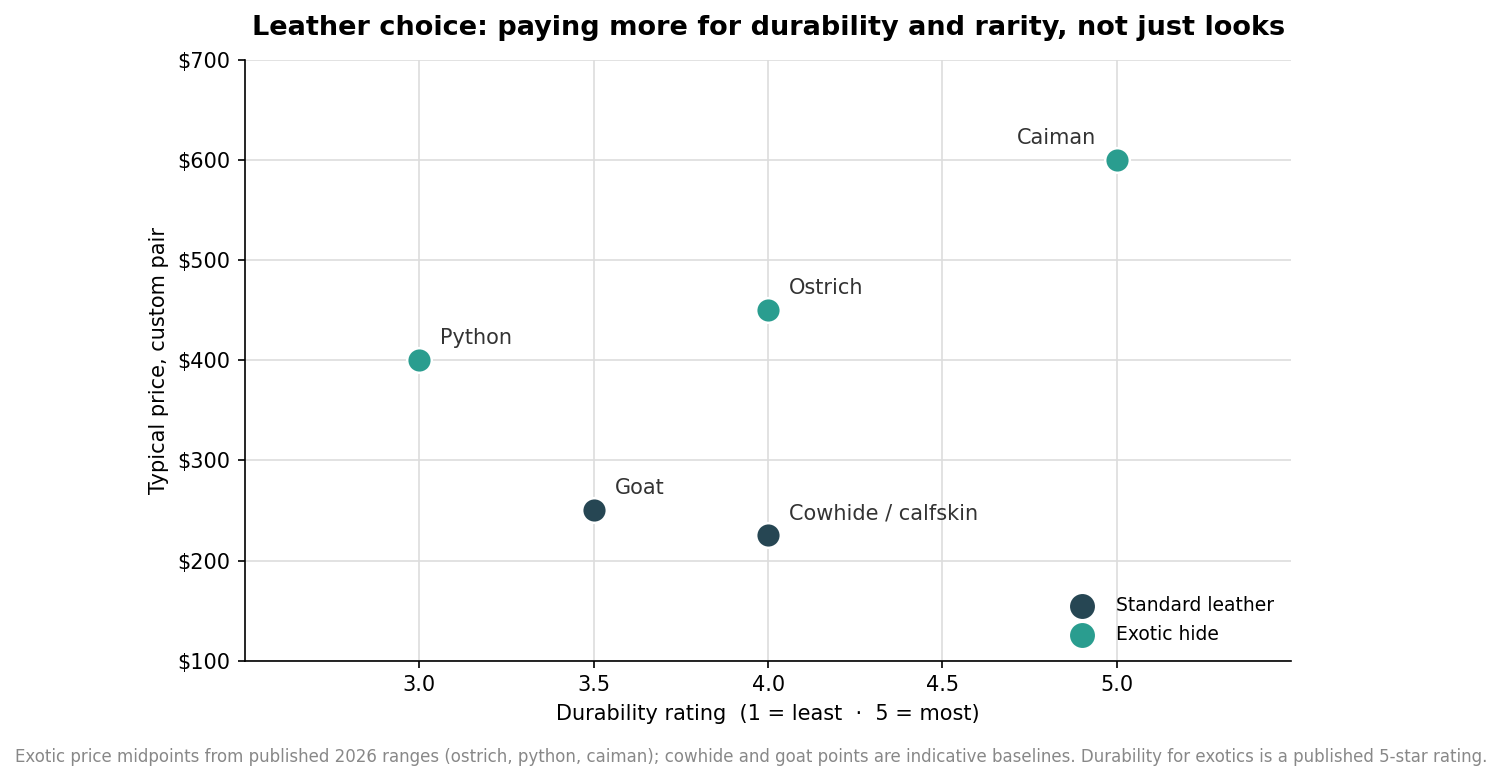
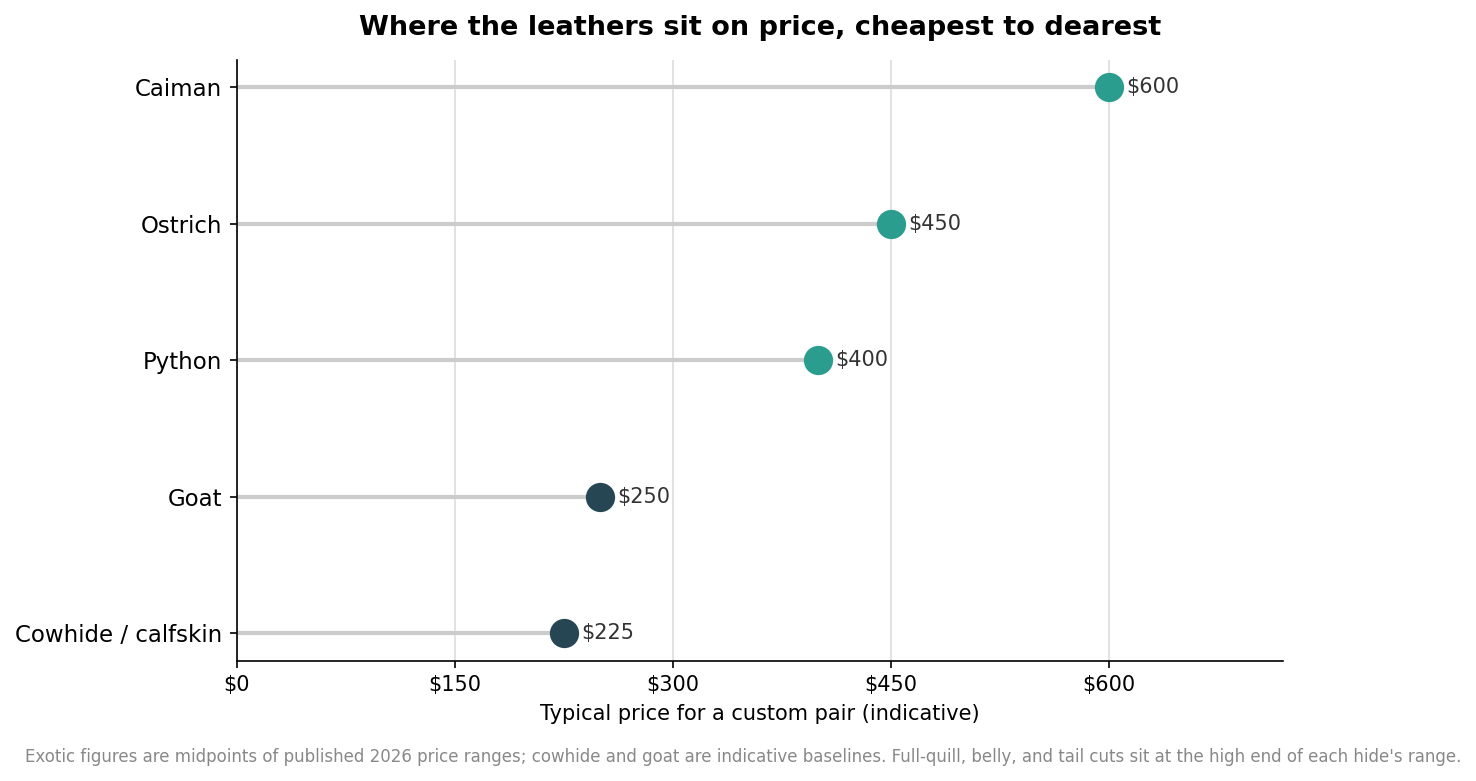
The temptation with custom boots is to assume that more money always buys a tougher boot. It does not. Exotic hides command a premium as much for their rarity and appearance as for their wear, and a well-made cowhide boot can outlast a delicate exotic while costing a fraction as much. The chart below plots typical price against durability so the tradeoff is visible: caiman earns both its durability and its price, ostrich is genuinely tough and mid-priced among exotics, and python costs exotic money while wearing less like leather and more like a specialty finish.
The exotic hides, hide by hide
Ostrich is the exotic most people should look at first. The full-quill hide, with its distinctive raised bumps, is prized for durability and comfort; ostrich carries natural oils that keep it supple and breathable, and it earns a high durability rating among exotics. The catch is upkeep, since it wants regular conditioning to stay in that condition, and smooth or half-quill cuts cost less than full quill.
Caiman and alligator are the top of the class for toughness. The tile pattern and high-gloss finish read as luxury, and the scales are naturally water-resistant, which is part of why caiman is often rated the most durable exotic. The trade is maintenance and a specific failure mode: the leather can crack between the tiles if it dries out, so conditioning is not optional. It is also the most expensive of the common exotics.
Snake leathers, python and rattlesnake among them, deliver patterns nothing else can match, but they are the highest-maintenance option and the least durable of the exotics here, often in the five-to-ten-year range rather than the decade-plus of ostrich or caiman. Snakeskin tends to yellow with age, and dust collects under the scales, so it rewards careful, frequent cleaning. Sharkskin sits at the other extreme: it is among the toughest and most naturally water-resistant leathers available, but it is rare, expensive, and offered in few styles. Elephant is famously scuff-proof and tough, but supply is tightly restricted, which pushes it into the rare-and-costly corner.
Legality and sourcing you should ask about
Several of these hides, caiman, alligator, python, and elephant among them, come from species regulated under international wildlife-trade agreements. That is not a reason to avoid them, but it is a reason to buy only from makers who can document legal, traceable sourcing. A reputable boot maker will know exactly where a skin came from and under what permits. If a deal on an exotic seems too good and nobody can say where the hide originated, treat that as a warning rather than a bargain. Ask the question before you order; do not assume.
Matching the leather to how you will wear them
Work backward from use. If the boots are for daily wear, ranch work, a uniform program, or a bulk order where consistency and easy care matter, full-grain cowhide or goat will serve better and cost less than any exotic, and they will forgive the occasional missed conditioning. If the boots are a dress or statement pair and you are willing to condition them on a schedule, ostrich is the balanced entry into exotics, caiman is the durable splurge, and snake is the choice when the pattern is the whole point. Whatever the hide, plan for a break-in period, since even soft leathers need a few wears to mold to the foot, and stiffer full-grain and exotic skins take longer. Choose the leather for the life the boots will actually live, and both the fit and the price will make sense years down the line.