A custom cowboy boot is only as good as the measurements it is built from. Get the handful of numbers that matter right, make your style decisions on purpose rather than by default, and a bootmaker can build a boot that fits the first time. Leave them vague and you wait weeks for something that pinches at the ball of the foot or gaps at the calf. This walkthrough covers exactly what to measure, how to measure it, and how to write it down so the person cutting the leather builds what you actually meant.
Start with the foot, not the size tag
Foot length is the anchor for everything else. Stand on a sheet of paper in the socks you plan to wear with the boots, trace around each foot, and measure heel to longest toe. Do both feet and build to the larger one, because most people have a mismatch of a few millimeters. A Brannock device, if you can get to one, gives you length, ball width, and arch length in one pass, and the arch length in particular tells the maker where the widest part of your foot actually sits.
Ball width is the second number. A cowboy boot has no laces to take up slack, so width is set entirely by the last and the leather. Widths are usually given as letters, from a narrow B through the common D up to EE and wider, and a boot that is one width too narrow will never break in comfortably no matter how long you wear it. Measure the circumference around the widest part of the ball of the foot, not just the flat width, since two feet with the same width can have very different volume.
Instep is the number most people forget, and it is the one that decides whether you can get the boot on at all. Because you pull a cowboy boot on over the top of the foot, a high instep needs a taller opening or the boot simply will not go past the arch. Measure the circumference over the highest point of the instep. A high reading is not a problem as long as the maker knows about it; a surprise high instep discovered after the leather is cut is a remake.
The shaft height and the calf
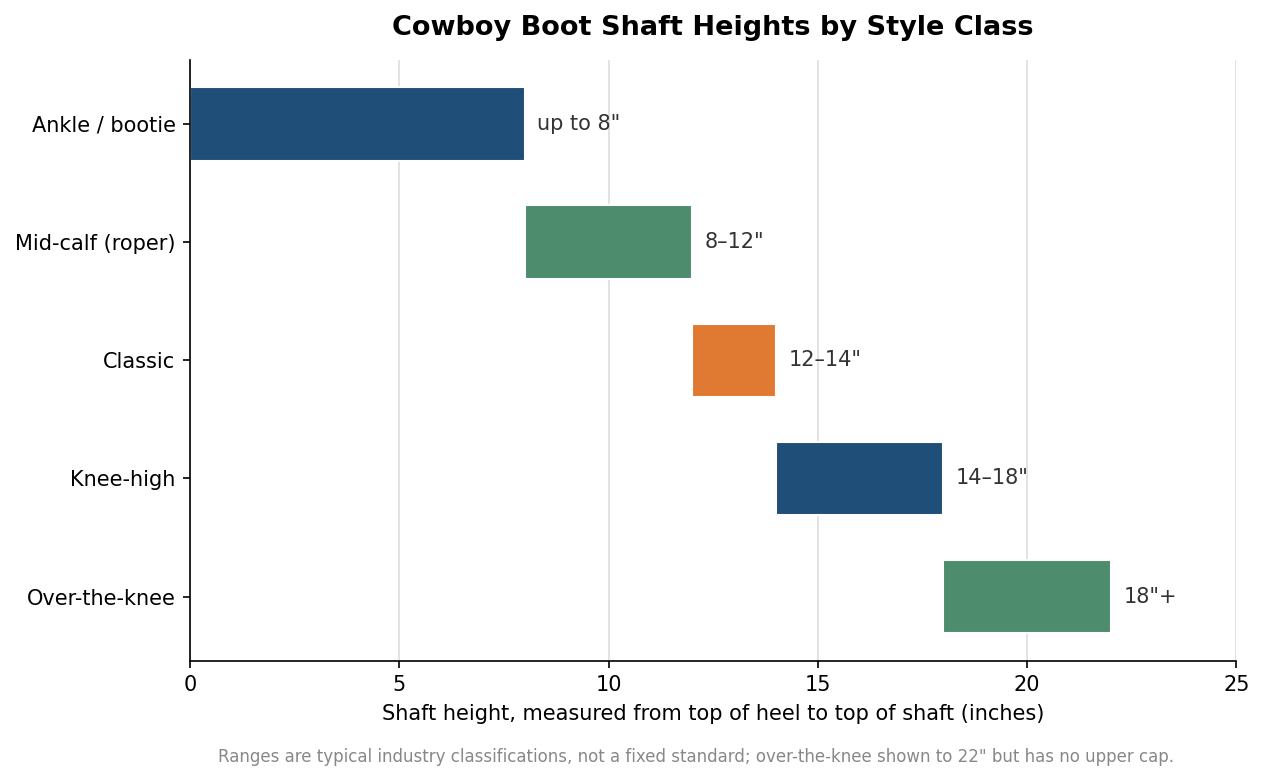
Shaft height is a style choice with comfort consequences. As the chart shows, an ankle or bootie height stops around eight inches, a mid-calf or roper shaft runs roughly eight to twelve, the classic cowboy silhouette lands at twelve to fourteen, and knee-high and over-the-knee options climb from there. Shaft height is measured from the top of the heel straight up to the top of the shaft, not along the curve, so quote it that way to avoid confusion.
Calf circumference becomes the make-or-break number as the shaft gets taller. Measure around the fullest part of your calf, over the pant leg and sock you will actually wear, and add a little room rather than pulling the tape tight. Too tight and you fight the boot every morning; too loose and a tall shaft folds and collapses at the ankle. On a classic twelve-to-fourteen inch shaft a standard calf opening usually works, but anyone with a fuller calf or who plans to tuck jeans in should call the number out explicitly.
Heel and toe: function first, then looks
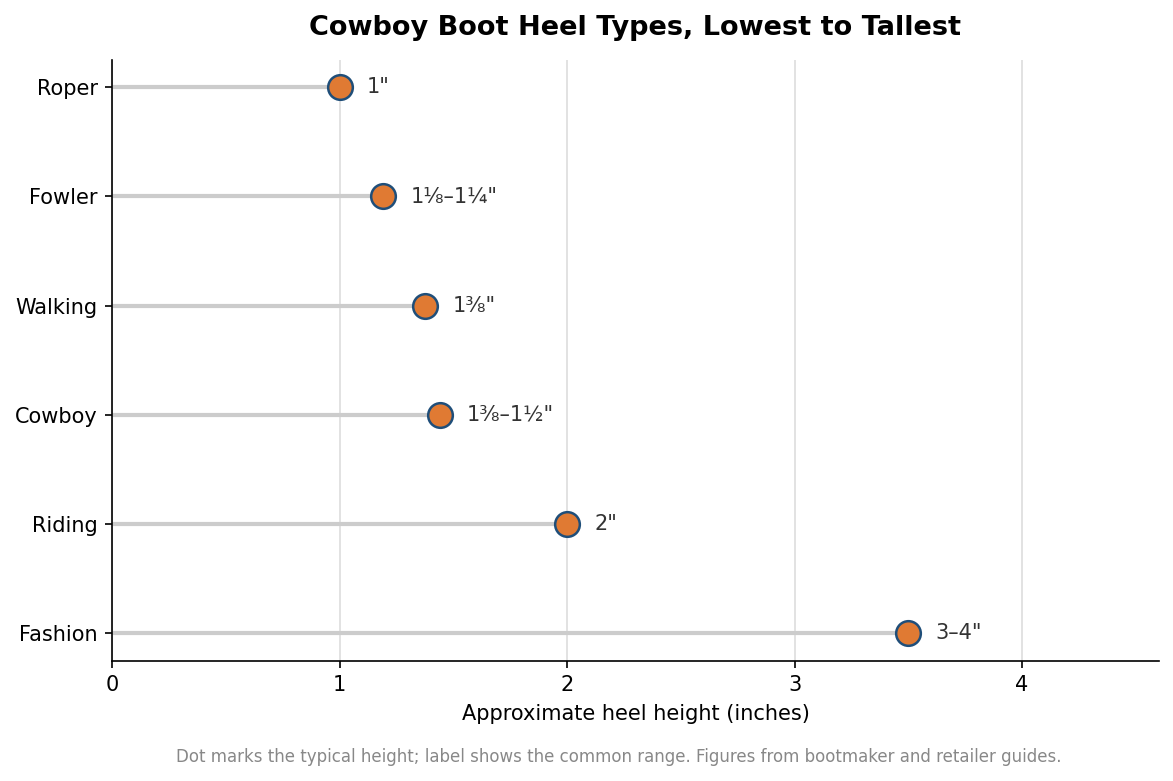
Heel height is where function and appearance pull in different directions, and the spread is wider than most buyers expect. A roper heel sits at about one inch and stays stable whether you are walking a job site or stepping in and out of a stirrup. Walking and traditional cowboy heels run from roughly one and three-eighths to one and a half inches, tall enough to sit securely in a stirrup and keep the foot from sliding through, but still walkable. A riding heel near two inches is built for the stirrup first and is not meant for a day on your feet, and a fashion heel of three to four inches is purely a look. Choose the heel for how the boots will actually be used, then let style follow.
Toe shape interacts with your length measurement more than people realize. A round toe uses the toe box efficiently, while a sharp pointed or snip toe pushes the tip of the boot well past the end of your foot, so the same foot often needs a touch more length in a pointed last to avoid crowding. Decide toe shape before you finalize length, and tell the maker which last you are building on so the two numbers agree.
Write the spec so it cannot be misread
Put every decision on a single sheet: length for both feet, width letter, instep circumference, calf circumference, chosen shaft height, heel type and height, toe shape, leather, and stitch pattern and color. Note plainly whether the measurements were taken barefoot or in socks, because a maker who assumes the wrong one will build a boot that is off by exactly the thickness of your sock. Photograph your foot tracings next to a ruler and send them along; a picture resolves ambiguities that words cannot.
For a bulk or team order the same rules apply, with one extra decision up front: whether you are sizing each wearer individually or ordering against a standard size run. Individual sizing fits noticeably better and is worth it for boots people will wear hard, but it lengthens the timeline because every pair is its own spec. A size run is faster and cheaper and fine for lighter use, as long as you collect at least length and width from each person rather than guessing off their street shoe size.
Set expectations on time and cost
Price moves with leather, construction, stitching, tooling and quantity, and exotic leathers and heavy tooling add meaningfully, so the useful number is a quote for your exact spec: Customized Cowboy Boots sends a free mockup within 24 hours and an exact price before you commit. Lead times vary widely across the market, and a one-person bespoke shop may be booked far in advance; with Customized Cowboy Boots, standard production ships in about 2 weeks after mockup approval, with faster turnaround available through express shipping. Whoever you order from, confirm the lead time in writing before you commit, especially when the boots are tied to a wedding, a team, or an event with a fixed date. A boot built from careful measurements is worth the wait, but only if the wait ends before you need to wear them.