When people compare custom cowboy boots, they compare leather, toe shape, and stitching before they get anywhere near the one spec that decides whether a boot is a twenty-year investment or a two-year disposable: how the sole is attached to the upper. Construction is invisible on a spec sheet and easy to skip past, but it sets the ceiling on everything downstream, including how many times the boot can be rebuilt and what each rebuild will cost. For a bulk order, where the difference multiplies across dozens or hundreds of pairs, it is the spec worth arguing over first.
Goodyear welt: the western workhorse
The Goodyear welt is the default for serious western boots, and for good reason. A leather strip, the welt, is stitched to the upper and the insole, and the sole is then stitched to the welt. That extra layer does two things: it creates a buffer that keeps water from wicking straight up into the boot, and it lets a cobbler remove and replace the sole without cutting into the upper. The trade-off is a slightly stiffer boot and a longer break-in than a thinner construction, plus a higher price at purchase. For boots that will see real mileage, that is usually the right trade.
Stitchdown and handwelt: the durable extremes
Stitchdown construction flares the upper outward and stitches it directly down to the midsole, which produces an extremely stable platform common on Pacific Northwest work boots. It is rugged and resoleable, but not by just any shop, so a bulk buyer should confirm a repair path before committing. At the far end sits the handwelted boot, where the welt is sewn by hand rather than glued and machine-stitched. Handwelted boots can be resoled essentially without limit, because there is no cemented welt layer to destroy in the process. That longevity comes at the highest price and longest build time, and it only pays off if the boots are genuinely kept in service for years.
Blake stitch and cemented: flexibility versus a dead end
The Blake stitch runs a single line of stitching straight through the insole, sole, and upper, with no welt in between. The result is a lighter, more flexible boot that needs little break-in, which is why it dominates dressier Italian footwear. The downsides matter for western wear: the stitch channel gives water a more direct path inside, and resoling requires a specific Blake machine that not every cobbler owns, so a boot can typically be redone only once or twice before the leather around the stitch gives out.
Cemented construction glues the sole on with no stitching at all. It is the cheapest to make and the lightest to wear, and it is a dead end for repair. Once a cemented sole peels or wears through, the boot is effectively finished, because a rebuild rarely costs less than replacement. For a disposable promotional item that may be worn a handful of times, that can be an acceptable choice; for anything meant to last, it is not.
What a rebuild actually costs
The reason construction matters for cost is that a resoleable boot has a second, third, and fourth life, each far cheaper than a new pair. A heel cap or toplift is the smallest repair, a fresh sole on the same footbed costs more, a full cowboy-boot resole more again, and a complete rebuild that replaces the sole, welt, and footbed sits at the top — yet even a full rebuild costs a fraction of a new custom pair. Cobbler prices move with sole material and region, but that shape holds everywhere.
Set those repair costs against the cost of a quality custom pair and the logic is straightforward: paying to resole a quality boot every few years is dramatically cheaper per year than replacing it, as long as the construction allows the resole in the first place. That last clause is the whole point.
How construction sets the ceiling on resoles
A boot can only be rebuilt as many times as its construction permits, and the gap between methods is enormous. A cemented boot offers zero rebuilds. A Blake-stitched boot gives you one or two before the stitch channel fails. A machine Goodyear-welted boot can usually be rewelted several times, roughly four to six, before the welt leather is too chewed up to hold. A handwelted boot can come back to the cobbler more or less indefinitely.
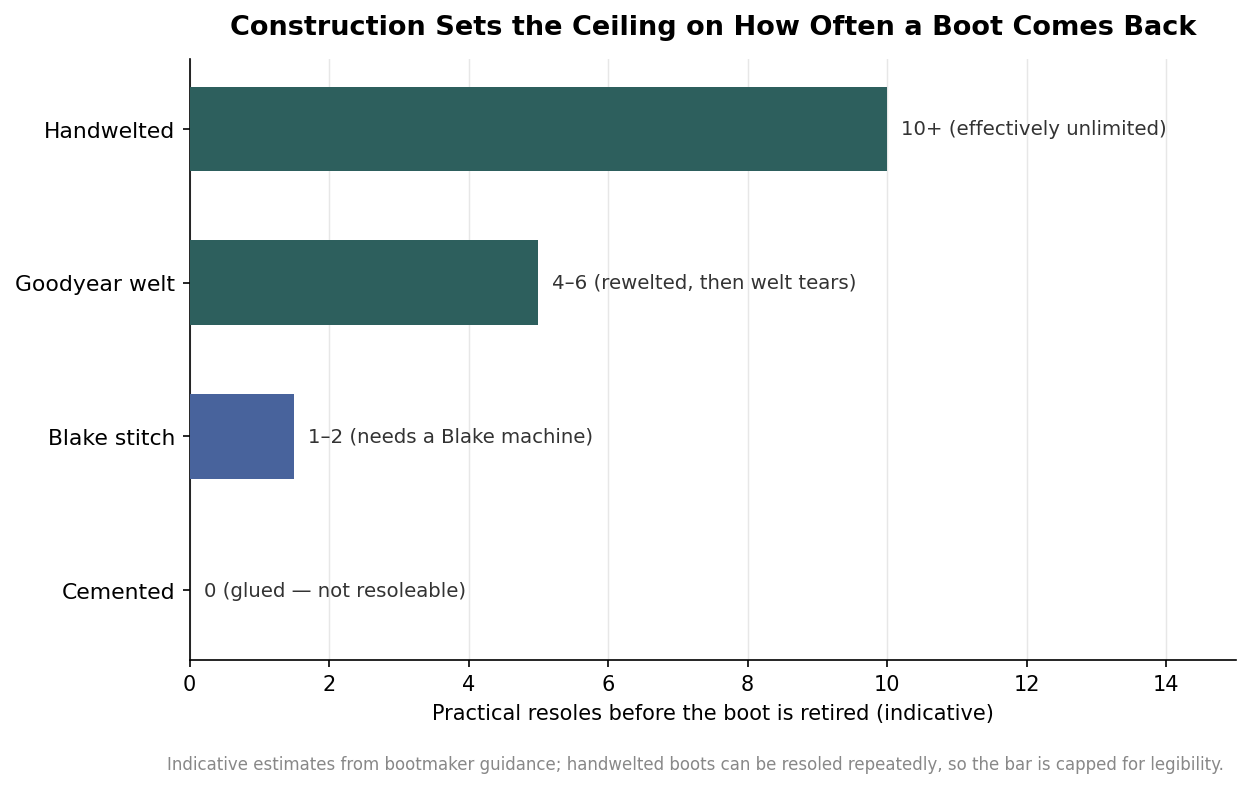
These counts are indicative rather than promises, and a careful wearer will stretch them while a hard one will not. But the ranking never changes, and it is the single best predictor of cost per year of wear. For a bulk program, it also determines your total cost of ownership across the fleet, since a construction that allows rebuilds turns a recurring replacement expense into a much smaller maintenance line.
Specifying construction on a bulk order
When you place a large order, name the construction explicitly rather than leaving it to the default, and match it to how the boots will be used. Goodyear welt is the safe center of gravity for boots that will be worn hard and kept for years. Handwelt is worth the premium only where boots are genuinely maintained over a long life. Blake or cemented can make sense for light-duty or short-run pairs where flexibility or unit cost outranks longevity. Confirm one more thing before you sign: that there is a realistic resole path for whatever construction you choose, because a durable boot with no one to rebuild it is just an expensive one. The resole counts here are drawn from published bootmaker and cobbler guidance and should be treated as planning ranges, not promises; for an exact price on your order, ask Customized Cowboy Boots for a free quote.