Most people who end up disappointed with a pair of custom cowboy boots did not get a bad boot. They got a good boot and then made one of a handful of predictable mistakes in the first month of owning it. Custom work removes the sizing excuses, which means the remaining failure points move to what happens after the box is opened: how the boot is broken in, how it is cared for, and how quickly the owner decides something is wrong. These are the errors worth knowing about before you spend the money.
Mistake one: judging the fit on day one
A new boot built with vegetable-tanned leather soles, insoles and heel counters is stiff by design, and that stiffness is not a fitting error. Over the first weeks of wear the leather softens, gives, and begins conforming to the shape of your foot, including accommodating a high instep or a pressure point that felt tight at first. Slight discomfort out of the box is normal and does not by itself mean the size is wrong. The mistake is sending boots back, or worse, attacking them with stretching tricks, before the material has had a chance to do what it is built to do. Snugness across the instep that eases with wear is break-in. Sharp pain, heel slip that never settles, or numbness in the toes is a fit problem, and those are the signals worth acting on. Learn the difference before you reach for a remedy.
Mistake two: forcing the break-in
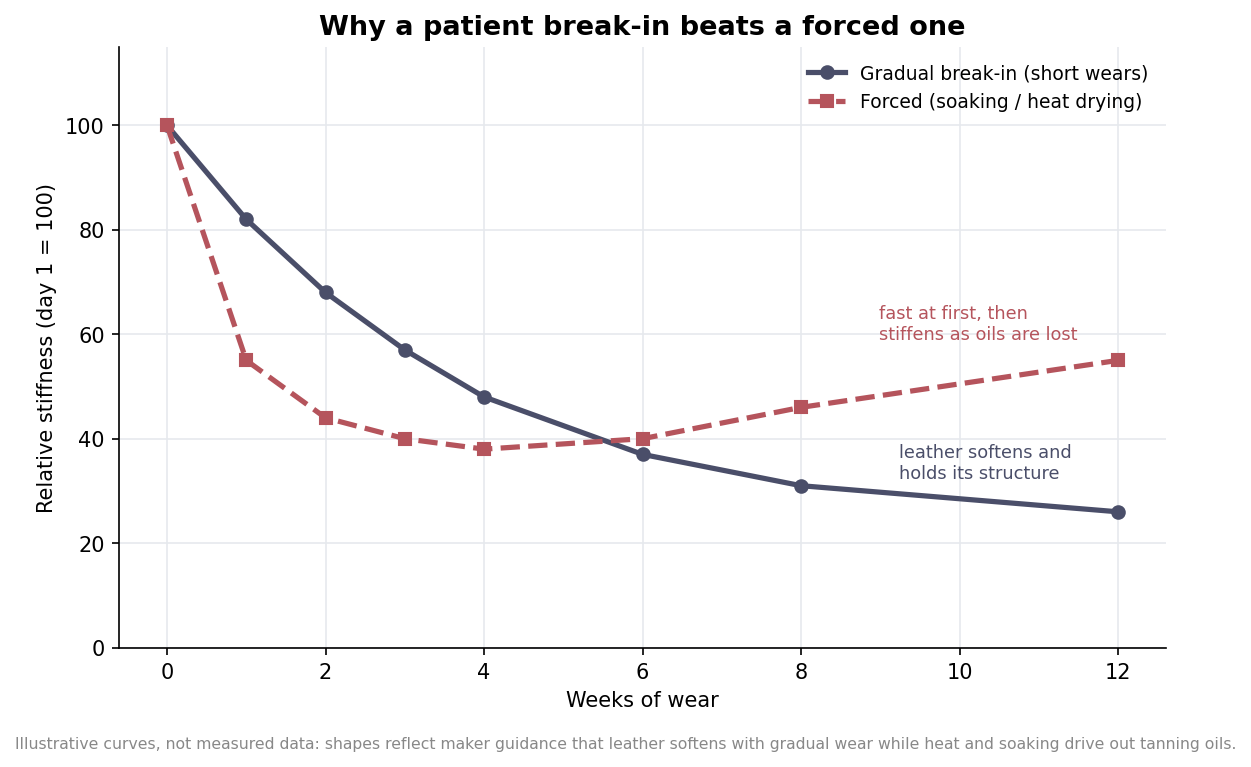
The internet is full of shortcuts, and most of them shorten the life of the boot rather than the break-in. Soaking leather to stretch it, parking boots near a heater, or running a hot dryer over them drives out the tanning oils that keep the fibers supple, and leather that dries too fast gets brittle and cracks at the flex points. The patient method costs nothing: wear the boots for short stretches indoors, an hour or two at a time, over several days, with thicker socks if the instep is tight, and let the leather move on its own schedule. A boot broken in gradually molds specifically to how you walk and ends up fitting better than one that was forced.
Mistake three: conditioning on the wrong schedule
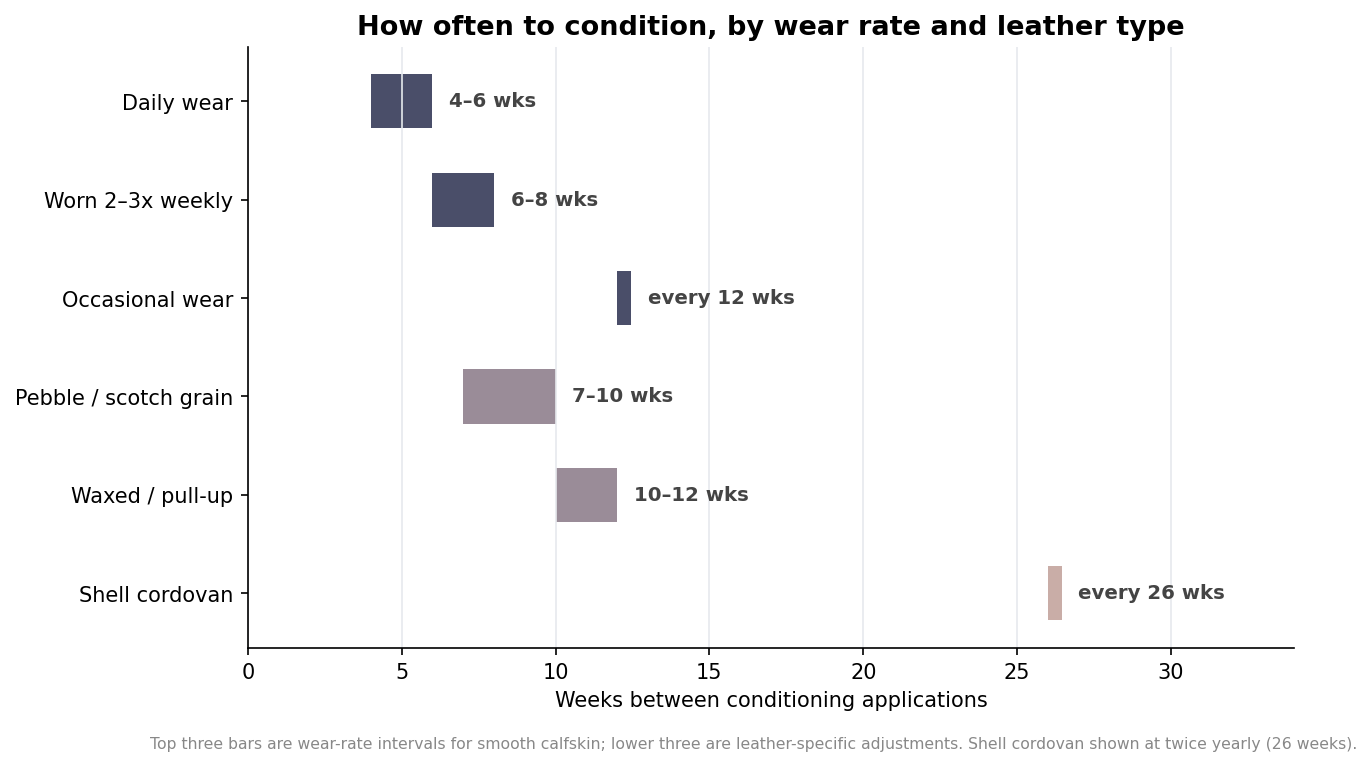
Two opposite errors show up here, and both shorten the boot’s life. The first is neglect, letting the leather dry until it goes dull, stiffens when flexed, absorbs water instead of beading it, or shows fine cracking at the toe box crease. Those are late warnings, not early ones. The second and more common error among enthusiastic new owners is over-conditioning. Saturating the fibers softens the leather past its intended character and leaves a tacky surface that grabs dirt and refuses to hold polish. The useful rule is to let the leather feel dry to the touch before the next application, and to apply sparingly, a pea-sized amount per boot, worked into the welt seam, toe box and heel counter and given at least twenty minutes to absorb before buffing. Frequency should follow how hard the boots actually work rather than a fixed calendar.
Mistake four: treating every leather the same
Conditioning frequency is not a single number across the catalog, and applying a calfskin schedule to an exotic or a specialty finish is a good way to ruin it. Smooth calfskin tolerates the standard schedule. Pebbled and scotch grain leathers want roughly twenty percent less. Waxed and pull-up leathers stretch out to every ten to twelve weeks and prefer a conditioner made for them. Shell cordovan should be conditioned no more than twice a year, because over-treatment damages its finish. Patent leather should never be conditioned at all; it wants a dedicated cleaner and nothing else. If your custom order pairs an exotic vamp with a calfskin shaft, you are effectively maintaining two materials on two schedules, and it is worth asking the bootmaker exactly what each panel wants before you start.
Mistake five: skipping the boring maintenance
The habits that extend boot life the most are the least interesting ones. Clean before conditioning, because working product over road salt and grit grinds it into the leather. Use cedar boot trees between wears so the shaft holds its shape and the interior moisture gets pulled out rather than sitting against the leather overnight. Give boots a rest day between wearings so the lining can fully dry, which is the single cheapest thing you can do for a pair you love. And condition roughly every three months even when the boots have barely been worn, because leather dries out on the shelf as surely as it does on the trail. A common maker recommendation for cowboy boots specifically is exactly that: condition every three months and store on cedar trees.
The mistake that costs the most
The expensive error is waiting too long to resole. A leather sole is a wear item and it is supposed to be replaced; the welt and the upper are the parts you paid for. If you keep walking on a sole that has worn through, the damage moves into the welt stitching and eventually the upper, and a routine resole turns into a rebuild or a write-off. Check the sole at the ball of the foot and the outside heel edge periodically, and get the boots to a cobbler while there is still material left to work with. Owners who resole on time can run the same pair for many years; owners who wait usually get one life out of a boot that was built for several.